A bar in music, also called a measure, is a unit of time that holds a set number of beats, defined by the time signature. In 4/4 time, each bar contains four quarter-note beats, counted 1, 2, 3, 4, before the count restarts at the next bar. Vertical bar lines mark where each bar begins and ends in written music.
In music production, bars are how you build drum patterns, set loop lengths, and arrange song sections in a digital audio workstation (DAW). This guide explains bars vs. measures, beats and time signatures, bar lines, common bar patterns, and how to count bars.
What Is the Difference Between a Bar and a Measure?
Bar and measure are two names for the same unit of music. Measure is more common in American English, while bar is standard in British English and in music production, where DAW rulers count time in bars and beats. "Four bars" and "four measures" describe the same length of music.
However, a bar line is different from a bar or measure. It refers to the vertical line in musical notation that separates one measure from the next.
What are the Parts of a Bar in Music?
The main parts of a bar in music are beats, the downbeat, and beat subdivisions. Beats provide the steady pulse, while the downbeat marks the first beat of each measure. These beats can also be divided into smaller note values, called subdivisions, to create different rhythmic patterns.
Beats and the Downbeat
A beat is the steady pulse you tap along to, and the downbeat is the first beat of each bar. The speed of the beat is the tempo, measured in beats per minute (BPM): at 60 BPM each beat lasts one second, and at 120 BPM it lasts half a second, provided the beat value remains the same.
Not every beat needs to have a drum hit or another sound. Even when some beats are silent, the underlying pulse continues and helps musicians stay in time.
The downbeat usually feels strongest. In 4/4, it falls on count one, and the count restarts after beat four:
| Bar | Count | Beats in the song |
|---|---|---|
| 1 | 1 - 2 - 3 - 4 | 1-4 |
| 2 | 1 - 2 - 3 - 4 | 5-8 |
| 3 | 1 - 2 - 3 - 4 | 9-12 |
| 4 | 1 - 2 - 3 - 4 | 13-16 |
The downbeat isn't always the loudest beat. Many pop and rock drum patterns accent beats two and four with the snare, which is called a backbeat. Accents placed between beats or on weak beats create syncopation.
Beat Subdivisions
Beat subdivisions split each beat into smaller, equal note values, so you can play faster rhythms without changing the tempo.
In 4/4 time, where a quarter note represents one beat, each beat can be divided into two eighth notes or four sixteenth notes. Another common division is the eighth-note triplet, where three equally spaced notes fit into one quarter-note beat.
The table below shows how these subdivisions are counted:
| Subdivision | Notes per quarter-note beat | Count |
|---|---|---|
| Eighth notes | 2 | 1 & |
| Sixteenth notes | 4 | 1 e & a |
| Eighth-note triplets | 3 | 1-trip-let |
For example, a drummer may play the kick on every quarter-note beat and the hi-hats on eighth notes. Switching the hi-hats to sixteenth notes doubles the number of hits per beat at the same tempo, while eighth-note triplets give a rolling, three-part feel used in shuffles and many trap hi-hat rolls.
How Do Bars Work With Time Signatures?
A time signature defines the rhythmic units within each bar and how they are grouped. In simple meters such as 3/4, the quarter note represents one beat. In compound meters such as 6/8, six eighth notes are grouped into two main beats, each lasting a dotted quarter note. Although 3/4 and 6/8 contain the same total notated value, their rhythmic groupings differ, and their durations in seconds depend on tempo.
How to Read a Time Signature
A time signature has two numbers that show how beats are organized within a bar. The top number indicates the number of written units, while the bottom number identifies their note value. For example, a 4/4 bar can contain four quarter notes, two half notes, eight eighth notes, or a combination of notes and rests with the same total duration.
Here is what each number represents:
- Top number: In simple meters, 3 indicates three beats, and 4 indicates four. In 6/8, six eighth-note units are grouped into two larger beats.
- Bottom number: The number 2 represents a half note, 4 a quarter note, and 8 an eighth note. In compound meters, it identifies the smaller unit rather than the main beat.
4/4 is also called common time and is sometimes written as a C symbol on the staff.
Bars in 4/4, 3/4, and 6/8 Time
4/4 groups four quarter-note beats per bar, 3/4 groups three, and 6/8 groups six eighth notes into two main beats.
| Time signature | Main beats in a bar | Main beat value | Count |
|---|---|---|---|
| 4/4 | 4 | Quarter note | 1 - 2 - 3 - 4 |
| 3/4 | 3 | Quarter note | 1 - 2 - 3 |
| 6/8 | Usually 2 | Dotted quarter note | 1-2-3-4-5-6 (accent 1 and 4) |
4/4 is simple quadruple meter: four quarter-note beats per bar, each dividing into two. It's the standard meter in most pop, rock, hip-hop, and electronic music.
3/4 is simple triple meter. Its three quarter-note beats create the repeating count often heard in waltzes.
6/8 is usually compound duple meter, with six eighth notes grouped into two main beats of three eighth notes each. Since a dotted quarter note equals three eighth notes, 6/8 and 3/4 have the same total duration but feel different, with two main beats in 6/8 and three in 3/4.
What Are the Different Types of Bar Lines?
The main types of bar lines in music are single, double, final, and repeat bar lines. Each serves a different purpose, from separating measures and marking changes between musical sections to indicating where a piece ends or a section needs to be played again.
Single, Double, and Final Bar Lines
A single bar line separates bars, a double bar line marks a new section or a change of key or time signature, and a final bar line ends the piece.
| Bar line | Appearance | Meaning |
|---|---|---|
| Single | One thin line | Separates measures |
| Double | Two thin lines | Marks a new section or a key or time signature change |
| Final | Thin line followed by a thick line | Ends a piece or movement |
Repeat Bar Lines
Repeat bar lines tell you to play a passage again. A thick and a thin line with two dots mark the repeated section, which you normally play twice unless the music says otherwise.
The main repeat markings include:
- Start repeat: Two dots on the right mark where the repeated passage begins.
- End repeat: Two dots on the left direct the musician back to the start repeat, or usually to the beginning if no start repeat appears.
- First and second endings: Brackets over the last bars of a repeat. Play the first ending on the first pass, then skip to the second ending after the repeat.
How Do You Count Bars in Music?
To count bars, count the beats in each bar aloud and restart at one on every downbeat, adding one to your bar count each time. To find how long a bar lasts, use this formula: bar length in seconds = 60 ÷ BPM × beats per bar. At 120 BPM in 4/4, one bar lasts 2 seconds and four bars last 8 seconds.
To count bars in a song:
- Find the pulse: Tap along with the steady beat, using a metronome if needed.
- Find the downbeat: Listen for the strongest beat, often marked by a kick drum, crash cymbal, or chord change.
- Count each bar: Say "1, 2, 3, 4" in 4/4 and restart at one on each downbeat.
- Track the bar number: Say the bar number on beat one instead of "one": "1, 2, 3, 4, 2, 2, 3, 4, 3, 2, 3, 4."
- Group bars in fours: Restart your bar count every four or eight bars to follow phrases.
What Are Common Bar Patterns in Different Genres?
Common bar patterns in music include groups of four, eight, twelve, sixteen, and thirty-two measures. Musicians use these patterns to organize verses, melodies, chord progressions, and solos, although the lengths vary depending on the song and genre.
Pop, Rock, and Electronic Music
Pop, rock, and electronic music usually organize ideas in four- and eight-bar groups. A four-bar chord progression often repeats twice to make an eight-bar section, with a change in the melody or drums on the second pass.
Some common groupings include:
- Four bars: Short chord progressions, melodies, and drum loops.
- Eight bars: Verses, choruses, and full phrases built from two four-bar ideas.
- Sixteen and thirty-two bars: Full sections in dance and electronic music, where new elements often enter or drop out on these boundaries. DJs use the same phrasing to line up mixes.
Hip-Hop, Rap, Blues, and Jazz
Hip-hop, rap, blues, and jazz use bars to organize lyrics, chord progressions, and improvisation, although the patterns differ across these genres.
- Hip-hop and rap: A 16-bar verse is a standard verse length, and hooks are often eight bars. Rappers vary their flow by placing words, pauses, and rhymes at different points in each bar. In hip-hop slang, "bars" also means rap lyrics, especially strong lines, although one written line doesn't always fill exactly one bar.
- Blues: The 12-bar blues uses three chords: I (tonic), IV (subdominant), and V (dominant). In C, these are usually played as dominant seventh chords: C7, F7, and G7. Each Roman numeral in the table is one bar; many versions change to IV in bar 2 (a "quick change") or add a turnaround in bar 12.
| Measures | Chords |
|---|---|
| 1–4 | I - I - I - I |
| 5–8 | IV - IV - I - I |
| 9–12 | V - IV - I - I |
- Jazz: Jazz commonly uses twelve-bar blues and thirty-two-bar AABA forms, along with other patterns. A typical AABA form has four eight-bar sections, where the A sections share a main musical idea, and the B section introduces a change, often called a bridge. However, jazz compositions can also follow different structures.
Why Are Bars Important in Songwriting and Music Production?
Bars help musicians structure songs, plan arrangements, and identify exact positions when recording or editing. They also make it easier to communicate changes during music production.
Using Bars to Structure Songs
Songwriters use bars to organize melodies, chords, and song sections. For example, two related four-bar melodies can form an eight-bar verse, and a 16-bar verse followed by an eight-bar chorus gives a song a predictable shape listeners can follow.
A phrase is a musical idea that feels complete, like a sentence. Four- and eight-bar phrases are most common, but phrases can also run five, six, or seven bars.
Using Bars to Create and Edit Loops
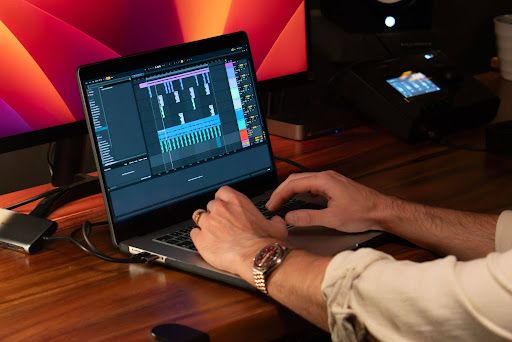
Your DAW's ruler shows the project in bars and beats, so you set loop lengths and edit points by bar number. To create a four-bar drum loop in 4/4:
- Set the meter and tempo: Choose 4/4 and a suitable BPM for your track.
- Set the loop range: Loop bar 1 to the start of bar 5. In Cubase, set the left and right locators and turn on Cycle; in Ableton Live, set the loop brace in Arrangement View.
- Choose the grid: Pick a sixteenth-note grid for drum programming, or a beat grid for broader edits.
- Build the pattern: Record or program four bars of drums.
- Duplicate or edit: Repeat the loop or adjust notes. Leaving some notes slightly off-grid keeps a human groove; audio loops may need short fades at the edges to prevent clicks.
How to Practice Counting and Recognizing Bars
To recognize bars and phrases, count along with a song you know and listen for what changes every four or eight bars. Practice these exercises:
- Count a verse: Count the bars in one verse of a 4/4 pop or hip-hop song. Most verses land on 8 or 16 bars.
- Spot phrase markers: Listen for drum fills, crash cymbals, and chord changes; they usually fall on the last bar or the downbeat of a new four- or eight-bar group.
- Use an accented metronome: Set the first click of each bar to a higher sound so you hear every downbeat.
- Switch meters: Count a waltz in 3/4, then a 6/8 song using its two main beats.
- Check in a DAW: Import a song, match the project tempo, and see whether section changes line up with bar numbers in the ruler.
Take Your Music From First Beat to Finished Track With Yamaha Creator Pass
Every great track starts with an idea. With Yamaha Creator Pass, you can turn those ideas into music with tools for production, sampling, mastering, and distribution.
Subscribe to Yamaha Creator Pass Growth or Pro to access Cubase 15 AI, 80,000+ samples through Output Arcade, 3 million+ loops and one-shots with LANDR Samples. Annual plans also include Ableton Live 12 Lite, giving you more ways to create and develop your sound.
Start your 7-day free trial of Yamaha Creator Pass and explore the tools to create, refine, and prepare your next track for release.
Frequently Asked Questions
How many beats are in one bar?
The number of beats in one bar depends on the time signature and beat grouping. A 4/4 bar has four quarter-note beats, while 3/4 has three. In 6/8, six eighth-note units usually form two larger beats per measure.
How many bars are in a song?
There is no fixed number of bars in a song. The total depends on the arrangement, tempo, and length of each section. A short song may use fewer measures, while an extended arrangement may use many more.
What does 16 bars mean in music?
Sixteen bars means sixteen measures in a row. In 4/4, they contain 64 quarter-note beats, but their length in seconds depends on tempo. Other time signatures change the number and grouping of beats within those measures.
What is a four-bar phrase?
A four-bar phrase is a musical idea that lasts four bars and feels complete, like a short sentence. Two four-bar phrases often pair up as a question and answer to form an eight-bar section.
How do you count bars when making beats?
Read the bar numbers on your DAW's ruler instead of counting aloud, and build your beat in four-bar loops. Then plan sections in multiples of four, such as an eight-bar intro, 16-bar verse, and eight-bar hook, and place drum fills or changes in the last bar of each section.